
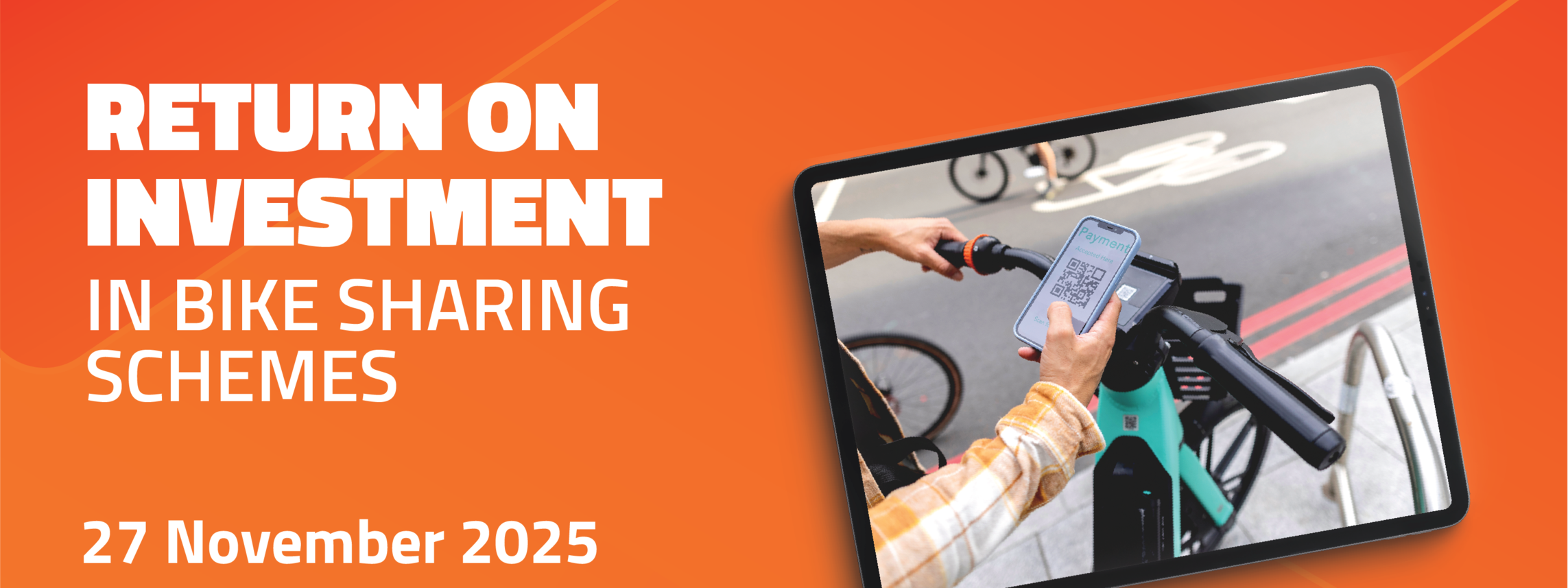
Is bike-sharing worth the investment? Key takeaways from our special In Conversation webinar on the latest bike-sharing ROI study
A groundbreaking study reveals the real economic impact of bike-sharing schemes across Europe, and the numbers might surprise you. The study was the central topic of the last In Conversation webinar with Marcin Chojnacki, Innovation officer specialised in Active Mobility.
When city officials debate whether to invest in bike-sharing programmes, they're often met with familiar arguments: bikes are healthier, more sustainable, better for the environment. But are these "soft benefits" enough to justify significant public investment?
A new study conducted by EY, co-funded by EIT Urban Mobility and Cycling Industries Europe, cuts through the rhetoric with hard numbers, and the findings challenge common assumptions about urban mobility investments.
The bottom line: does bike-sharing pay off?
For every €1 invested in bike-sharing schemes, cities see a return of €1.10 in quantified benefits. But here's where it gets interesting: this figure could rise to €1.75 by 2030 if bike-sharing is strategically prioritised.
While these benefits don't translate directly into city revenue, they deliver tangible value across three critical dimensions: social, environmental, and economic. But what exactly are these "positive externalities," and how do they work?
Beyond the obvious: what most people miss about bike-sharing
What's the single largest contributor to bike-sharing ROI?
It's not emissions savings or health benefits, though those matter. The answer might surprise you, and it reveals why bike-sharing is more than just a transportation option.
Bike-sharing schemes support over 6,000 jobs across Europe, with an average of one job per 75 shared bikes. For example, in cities like Geneva, these schemes have helped transform vulnerable communities by providing employment opportunities and skills development.
The hidden cost of traffic jams
Did you know that residents in at least four European capitals lose over 100 hours annually just sitting in rush hour congestion? That's more than four full days of lost time every year.
Bike-sharing schemes address this in ways that go beyond simply "avoiding traffic." The study quantifies exactly how much productivity is recovered and translates it into concrete economic value. Approximately 760,000 hours are saved annually across Europe, translating to roughly €30 million in productivity gains. The webinar explores the methodology behind these calculations, including how bikes' higher average speed in urban traffic compared to cars factors into the equation.
The transport poverty solution no one's talking about
According to the Eurobarometer, cost and availability are among the biggest barriers to Europeans' daily mobility. Bike-sharing addresses both, but only when implemented correctly.
Two-thirds of bike-sharing trips replace a sedentary form of travel, meaning users are more active than they otherwise would have been. But beyond individual health benefits, bike-sharing can have a transformative effect on lower-income communities that cannot afford other traditional forms of transportation.
Lyon's approach demonstrates what's possible: the city offers half-price annual subscriptions for youth and unemployment benefit recipients, drastically improving their social mobility. However, the choice between publicly and privately operated systems significantly affects who benefits from these schemes. Private systems, when cities provide little funding, can become quite expensive (4-5 euros per ride), primarily serving higher-income users and tourists rather than addressing transport poverty.
Public health beyond individual users
The health benefits extend far beyond individual cyclists. The study finds that almost 1,000 chronic diseases are prevented annually across Europe through the impact of bike-sharing systems. This happens through two mechanisms: increased physical activity among users (with positive impacts on both physical and mental health, including reducing dementia risk) and reduced air pollution affecting the entire city population.
A healthier population means lower public healthcare expenditure and a more productive workforce, making this not just a public health argument, but an economic one.
Why 2030 could be a game-changer
The study projects that bike-sharing's economic impact could more than triple to over €1 billion annually by 2030. But this growth isn't guaranteed, it depends on four key trends converging at the right time.
Electric bikes are transforming the landscape, generating 31% of trips while representing only 21% of the fleet. Regulatory changes, including the 2021 European Urban Mobility Framework requiring all 420 major European cities to adopt urban mobility plans, are driving supply increases. On the demand side, urbanisation, low emission zones, and rising sustainability awareness (with 25% of Europeans intending to cycle more) are creating favourable conditions.
There's also significant room for territorial expansion: several European cities with more than 300,000 inhabitants still lack bike-sharing schemes, opening the door for at least 230,000 more shared bikes across Europe.
The complement, not competitor, to public transport
Bike-sharing and public transport are not in competition, they're complementary. Bike-sharing can significantly expand public transport's reach, particularly where transit stops are more than 400 metres from destinations. It can also ease saturation on important transit lines, essentially increasing public transport capacity at comparatively low cost.
Copenhagen's integration of bike-sharing management directly into the regional mobility authority demonstrates this approach's success, with 30% of trips now linked with other public transport modes.
Real challenges, real solutions
The webinar delves into the practical challenges cities face: procurement knowledge gaps between operators and cities, the need for cycling infrastructure investment alongside bike-sharing systems, and the exponential cost increase of serving city peripheries.
London's success story offers valuable lessons: cycling levels have doubled since 2022, with 40% of this growth driven directly by bike-sharing systems. Strategic placement in areas with limited public transport access has been key, with 23% of Lime users reporting improved access to jobs.
Rewatch the last In Conversation to learn more
The webinar goes far deeper than the highlights above, including:
- detailed ROI calculations and methodologies
- the pros and cons of docked versus dockless systems
- case studies from London, Copenhagen, Lyon, and Geneva
- practical recommendations for policymakers and planners
- insights on procurement best practices and cross-municipality coordination
- the future of electric bikes in bike-sharing schemes
- how cities can avoid common pitfalls that have led to system failures
Read the full study for the complete methodology, data, and insights that are shaping the future of urban mobility across Europe.
Check out the Active Mobility forum to learn more about the topic, and jump in with your thoughts, expertise, or any questions you may have!