
Innovation project success: improving interoperability and collaboration in urban logistics
Supply chain logistics in today's markets face increasing challenges, including:
- fragmented data across different technologies, making communication and coordination difficult between logistics actors
- lack of common standards in the labelling and tracking of goods
- the need to optimise processes to reduce resource use and minimise carbon footprints.
These issues increase the risk of errors, complicate incident resolution, increase operation costs and difficulty responding to market demands, and overall reduce operational efficiency.
Standtrack, which has benefited from EIT Urban Mobility co-funded pilots to refine and test their product and business model, has a solution to revolutionise transportation chain management. The innovation employs a single identification tag (IUB in Spanish), that allows continuous tracking and traceability of each package from the point of origin to its final destination.
The platform connects through APIs with the ERP systems of the different logistics actors, providing real-time visibility of the status and location of packages. Not only does this improve operational efficiency, but it also ensures that each participant has access to accurate and up-to-date information at all times.
In addition, Standtrack promotes fluid and constant communication between carriers, operators and other actors, optimising coordination and significantly reducing the risk of errors thanks to the standardisation of collaboration and traceability messages. With increased interoperability and collaboration between companies, this innovation makes it possible to optimise logistics and reduce environmental impact, by allowing the consolidation of goods as close as possible to their final destination.
The innovation has been tested in four cities: Madrid, Vitoria, and Valencia in Spain, and Braga in Portugal.
Making an impact
In Madrid, Standtrack was integrated into Citylogin’s TMS to enable full traceability along the transport chain. Goods were prepared at Citylogin's logistics platform and transported by electric van to the EMT Hub, where cross-docking allowed last-mile delivery with electric trolleys, eliminating vans in the city centre.
In Braga, the solution was integrated into Correos Express' TMS. While an initial test explored consolidating goods at a local hub for cross-docking with electric trucks, a direct delivery approach using electric vans proved more efficient. The city is also assessing a collaborative network of hubs and lockers to optimise urban logistics.
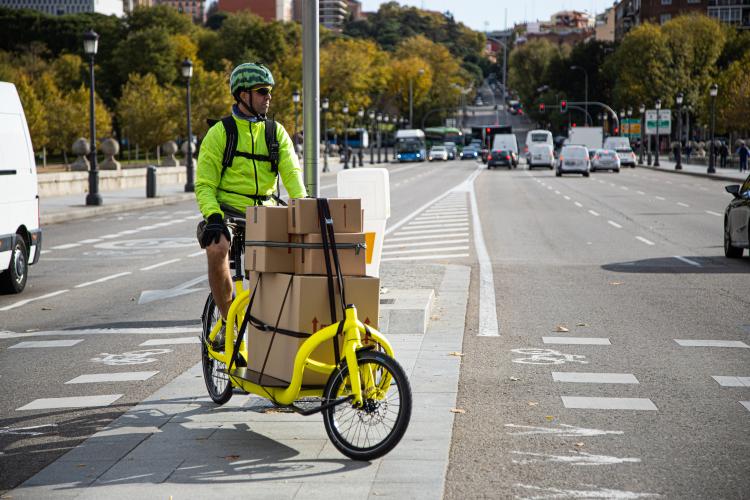
In Vitoria-Gasteiz, the pilot focused on integrating Standtrack into Eraman Coopcycle’s TMS to improve freight traceability. Packages from DHL and GLS were transported to the Eraman Hub, where cross-docking enabled last-mile delivery via cargo bikes, significantly reducing van usage in the city.
In Valencia, as part of efforts to restore logistics operations in the region following the DANA floods that hit the area in October 2024, T-box Solutions has integrated Standtrack to optimise consolidation and distribution. Goods are processed at logistics platforms in Paterna and Alcásser before being distributed efficiently to affected areas through an integrated system.
- 75% reduction of vans required for the urban deliveries
- 1.2 tonnes of CO2 reduced based on the distance travelled by the electric trolleys
- 6,000 fewer labels printed
- 1,000 daily goods delivered
Lessons learnt
Pilots are essential for change: implementing pilots is crucial to shifting the paradigm of urban logistics. These real-world tests help demonstrate the benefits of collaboration over competition and allow stakeholders to adapt to new models.
Continuous adaptation and improvement: while the current version of Standtrack provides a strong starting point, continuous improvement is necessary to meet the evolving needs of the logistics sector. Adapting the solution based on real-world feedback will ensure long-term success.
Public-private collaboration is key: Standtrack's close connection with city administrations positions it as a strategic tool for fostering collaboration in urban logistics. Strengthening this partnership will be critical for scaling the solution.
Expanding commercial adoption: beyond working with public authorities, engaging private-sector stakeholders such as retailers, manufacturers, and logistics operators is essential. A dual strategy that integrates both public and private players will accelerate adoption and create a more cohesive urban logistics ecosystem.
Discover more success stories and case studies from leading cities in our Marketplace.